

Blog
2027: A Defining Year for the Kraft Lignin Market
The commercial kraft lignin market is approaching an inflection point.
Today, demand for kraft lignin is exceeding supply. By late 2027, however, new production could dramatically change market dynamics. For the first time in several years, the market could shift from constrained supply to a period in which available production exceeds demand. The production capacity trend chart below shows the magnitude of this change.
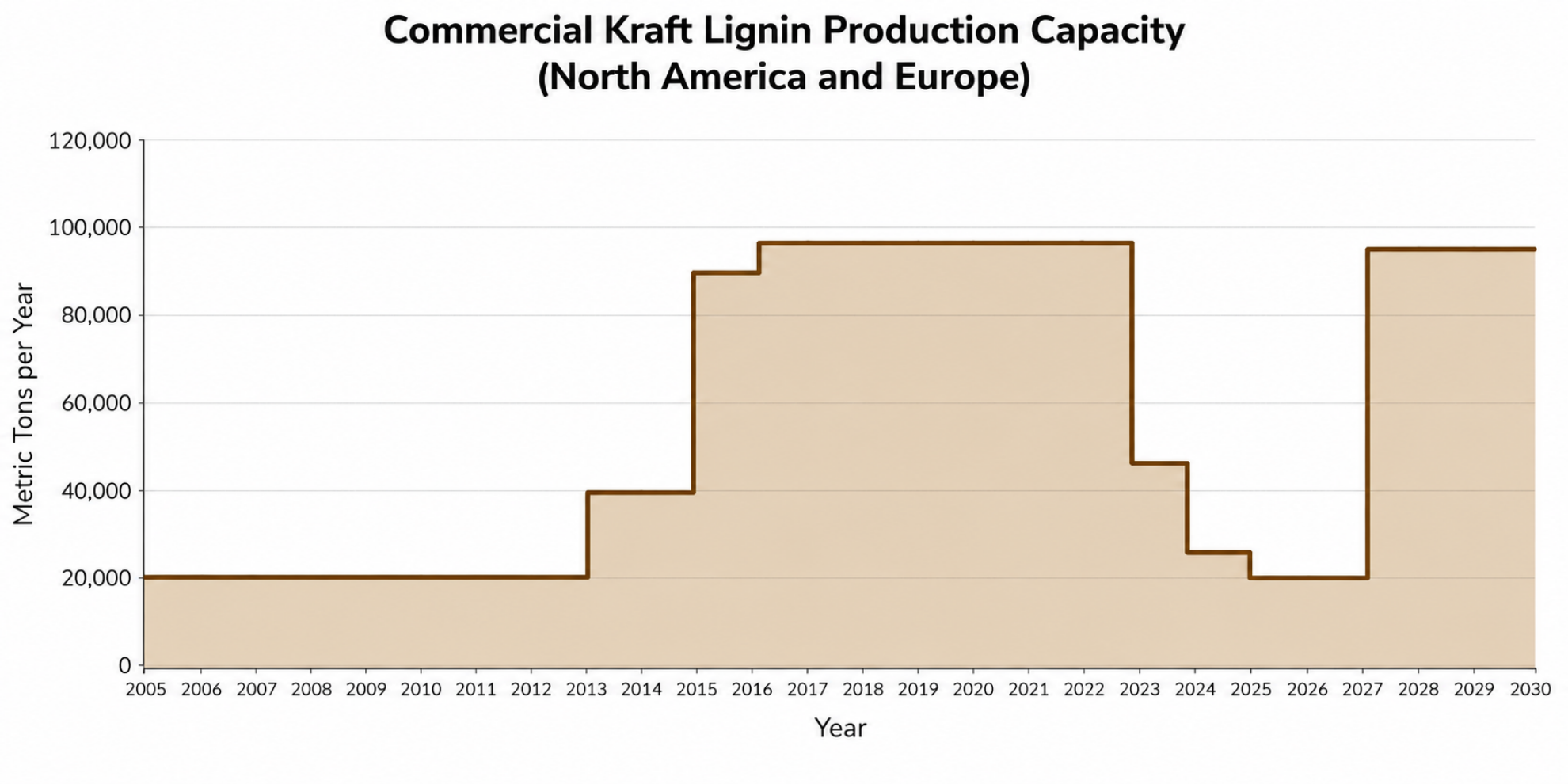
Figure 1. Commercial kraft lignin production capacity in North America and Europe.
As the chart illustrates, commercial kraft lignin production capacity in North America and Europe has been volatile over the last decade, the result of several mill closures. With new capacity expected to come online in 2027, available capacity is projected to increase dramatically. Given its magnitude, it represents a fundamental shift on the supply side of the kraft lignin market.
This should be great news for our industry. Greater availability can provide kraft lignin customers with confidence in long-term supply. For kraft pulp producers, a larger and more diverse customer base can improve the long-term economics of lignin recovery. However, if significant new volumes enter a market that cannot support the economics of commercial lignin recovery, prices could come under substantial pressure. We have seen this before.
Prior to 2023, kraft lignin was often sold at price levels that, in my view, did not adequately reflect the cost of production. If future market prices return to those levels, individual pulp producers may eventually conclude that lignin recovery no longer provides an adequate economic return. That would be a poor outcome for everyone, even if some customers benefit temporarily from lower prices. For many reasons, the solution is not to artificially restrict supply or try to maintain a particular market price. The solution is market development. Increased supply needs to be accompanied by increased demand. This creates an important opportunity for both sides of the market.
That alignment does not, and cannot, require industry-wide coordination. It requires individual producers and consumers to recognize that the long-term value of kraft lignin depends upon building commercially sustainable applications and supply relationships. REMEMBER – kraft lignin is not a waste product.
The challenge we face in 2027 is not whether the industry can produce enough kraft lignin. The challenge is whether the market develops enough valuable applications to support the kraft lignin it can produce. How successfully the industry answers that question could determine kraft lignin's commercial future for years to come.
WDM
All Lignin Is Not Created Equal
It is not my intention with this blog to share quality specifications based on my experience with kraft lignin customers. It does seem appropriate, and certainly not a violation of any confidentiality agreements, to share the following important observation: not all lignin is created equal.
Those who have studied lignin chemistry will readily attest to the fact that hardwood lignin is different from softwood lignin, and that sulfite lignin is different from kraft lignin. Still, I am somewhat entertained by the generalization of “lignin” and the expectation that a new lignin plant will produce a product just as effective or comprable in a specific application as the existing supply. If this is something you have been told, I encourage you to ask questions.
From my perspective and experience, even lignin produced using the same general kraft pulping process and the same tree species can behave differently in certain applications. Relatively small changes in the pulp mill or lignin separation process can be significant to lignin customers.
As one ponders the many possibilities for lignin, especially the more lucrative ones, I’ll make an assertion that I think will be valuable: many lignin customers are specialty chemical businesses, and certain properties of lignin that many consider minor are critical to their process and can produce recognizable changes in their product. Pulp mill operators may consider these changes insignificant. Specialty chemical businesses may consider them huge. This gap needs to be recognized and discussed. Collaboration between the producer and the end user on quality, along with the necessary financial alliances, is crucial to success in the kraft lignin industry.
Not all lignin is created equal.
WDM
A Leadership Challenge
Several weeks ago, I posted a blog titled “The Kraft Lignin Market No Longer Presents a ‘Chicken or Egg’ Paradox.” I suspect that article may have offended some people working in product development. If my words came across more harshly than I intended, I apologize. But I also make no apology for raising the issue. I call things as I see them. In this week's blog, I want to offer another unique, perhaps unconventional, perspective on the challenges we face in the forest products and biomaterials industry.
I was recently contacted by a senior-level executive in the R&D sector who made a comment along these lines:
“Biomaterials such as lignin would not be possible without pulp and paper mills, and as such, pulp and paper processing needs to take priority over biomaterials.”
I listened politely. There is, of course, some truth in the statement. Kraft lignin is produced by the kraft pulping process. Without kraft pulp mills, there is no kraft lignin. But the more I thought about the comment, the more it bothered me, not because he was technically correct about it, but because of the assumption behind it. It struck me as the kind of thinking that can easily become arrogance.
“The pulp and paper industry can no longer afford arrogance.”
Over the past two decades, hundreds of pulp and paper mills across North America and Europe have closed. History continues to demonstrate, time and again, that no industry is granted the right to remain economically relevant forever. For this reason, I applaud pulp and paper executives who are willing to seriously investigate biomaterials – the leaders who recognize something important: the mill of the future may need to derive substantially more value from a tree than what is produced through pulp and paper sales.
Yes, the biomaterials industry needs pulp mills. But the continuing closure of mills tells us something else: pulp mills need new sources of value. I have spent most of my career around the pulp and paper industry, and I have tremendous respect for the people who operate the mills. But respect for the past should never become complacency about the future. To quote Bob Dylan, “The times they are a changin'.”
Mills still derive the overwhelming majority of their revenue from pulp and paper production, and the continuing closure of mills demonstrates the weaknesses of that traditional model. Biomaterials such as lignin, meanwhile, have been slow to make a meaningful impact on a mill's bottom line. Shareholders continue to press CEOs for returns. Capital is limited. Markets are uncertain. The challenges seem endless.
So what's the answer?
I assert that, as an industry, we simply do not know the formula that will solve the major problems the pulp, paper, and biomaterial industry faces. This isn’t a concession; perhaps it is humility – a quality we all need. Isn’t it interesting that we routinely find ourselves in exactly the same position in our personal lives? We encounter job loss, financial problems, health issues, broken relationships, addiction, and countless other circumstances in which we simply don't know what to do. For many of us, there comes a point when we turn to the Lord for help. (because nothing else seems to work) Why, then, shouldn’t we do the same thing with our work when the answers and challenges are seemingly insurmountable?
Perhaps our industry leadership challenge isn’t to discover the next lignin-based product or technology. Perhaps the challenge lies with leaders who demonstrate humility, admit they don’t have all the answers, and that they need our prayers.
“Do not be anxious about anything, but in every situation, by prayer and petition, with thanksgiving, present your requests to God.” — Philippians 4:6
Integrity in the Lignin Business
What a strange topic for a kraft lignin blog, but this is important, especially for those just starting their careers or are new to the business.
The goal of this site is to be a “One Stop Shop” for everything related to kraft lignin, including decades of wisdom and experience in the business. I know many will read this, shake their heads, and continue searching for something they feel is more important. But what I am sharing in this blog should be given high priority. For those who read this and consider it folly, I challenge you to print this, put it somewhere safe, and revisit it every now and then as you gain experience.
In the kraft lignin space, you will meet all kinds of people. If you’re in this business, you will deal with pulp mill managers, researchers, private equity, and entrepreneurs. What a blessing and opportunity it is to work in a relatively small space where most people get to know each other. In this industry, you’ll learn who is trustworthy and who seems – well, less than honest.
A few weeks ago I was told about a group that had recently organized. Regardless of their business plan, I immediately thought to myself, “Here they go again taking someone’s money.” I recently read about a different project that had no chance of success, and I couldn’t help but think about the ones providing the funding. They would figure it out one day. And then there are others who genuinely work hard, are honest, and strive for something they truly believe will be successful – I love working with this type of person; most people do. There are those who are always willing to share their best advice with others, and then there are those who can't find time in their day to return phone calls – it doesn’t take long to figure out which group they’re in.
Over your career, you build a reputation that will follow you wherever you go. And over time, based on your notoriety, people will make both personal and business decisions about you. I strongly believe that many would love the opportunity to go back in time, return phone calls, help colleagues, and report more honestly on their project’s status. But it’s hard to go back.
Protect your reputation and integrity.
Dale Mitchell
Think Big - Like a CEO
As I write this blog, the target audience is primarily researchers or perhaps a pulp mill engineer interested in starting or justifying a lignin plant. The executives who read this blog will hopefully nod with approval.
The message today is “think big.” There are numerous commercial opportunities for kraft lignin that have been studied and, yes, developed. But many are just too small in scale to grab the attention of the CEO’s of the world. Here is what I’ve come to understand about senior leaders who are interested in biomaterials, or any other market for that matter. This is what gets them excited – big markets and good returns. They want to “move the needle” for their companies. Yes, a really “cool” or “neat” discovery is great for a company news release, but this isn’t what most CEO’s are looking for. They want big discoveries and innovation. And believe me, these guys made it to the top for a reason: they know the difference between a good public relations project and one that will improve the trajectory of their companies and their stock prices. Researchers and product developers, always ask yourself this question when considering a project: “Is this project big enough to move the needle at my company?” This is what your CEO is looking for.
Do you have trouble thinking big? If so, you’re not alone. But I encourage you to step out of that box and look at the world around you. Walk out on a clear night, think about how vast and huge our universe is, and the power of the One who created it. This is the One you need to go to when you’re searching for answers in life. If He can create this universe, then He can certainly help you with your lignin projects. I know; I’ve experienced His divine intervention.
“Now to him who is able to do far more abundantly than all that we ask or think, according to the power at work within us, to him be the glory in the church and in Christ Jesus throughout all generations, forever and ever.” Ephesians 3:20-21
As I wrote this blog today, it dawned on me repeatedly that many of you are hearing a perspective that may be new or unusual to you. Admittedly, with a background in pulp and paper, and a doctorate in ministry, I certainly have unique perspective, and I hope you learn from it. My hope and prayer is that my experience helps as you tackle the challenges not only with kraft lignin but with the world in which you live.
Think big, pray for guidance.
Dale Mitchell
The Kraft Lignin Market No Longer Presents a “Chicken or Egg” Paradox
When I began my journey into kraft lignin commercialization in 2012, there existed a “Chicken or Egg” paradox. The frequently asked question at the time was whether pulp and paper companies should invest in lignin separation plants with the hope that markets would develop, or whether markets should develop first. In this blog, I will assert that the paradox has finally been resolved.
There are different reasons why a pulp and paper company may want to invest in a lignin plant. There may be a need to debottleneck a recovery boiler, or, the pulp company may be looking for a new source of revenue. Regardless, pulp and paper companies have demonstrated that they can produce lignin, and material for testing is available to any researchers looking for samples. This was not always the case, but it is now. Responsibility for the next step has shifted and is now squarely on the shoulders of researchers, business developers, and end users. It’s time for developers to contribute more to this industry. It has taken too long for this market to develop. Still, I am pleased to acknowledge there have been some recent innovations that are truly incredible and commercial.
The commercial kraft lignin industry no longer faces a true “chicken or egg” paradox. The egg has been laid. It is now up to the marketplace to prove the eggs can hatch. I understand progress has been made, save the emails, but it has progressed at a painfully slow pace. Pulp and paper companies are waiting on you, Product Developers, not vice versa. It’s time to step things up.
What I’ve just shared is my observation from over a decade in this industry. This was not a dress-down in the boss's office or part of a performance review; it was merely an observation from someone who cares deeply about this fantastic and incredible molecule we work with, who wants to call out the obvious. I see where this industry is falling short. And I understand, more than most, how difficult it is to fully comprehend lignin chemistry and commercialization. I also recognize it is similar in ways to the miracles we see every day, all around us.
With that, I want to conclude this week’s blog by sharing St. Augustine’s “Doctrine of the Two Books.” In our quest for knowledge, Augustine asserted that God has given us two books, the Book of Scripture and the Book of Nature. Let the Book of Scripture, he said, be a book so that you can hear it. Let the Book of Nature be a book so that you can see it. In your search for knowledge, use both of these books. Most of us will use the Book of Nature as we try to decipher this complex molecule we call lignin, but don’t forget, there’s another book, the Book of Scripture, there for you as well.
Dale Mitchell
The Future of Commercial Kraft Lignin Depends on Partnerships, Not Price
One of the greatest misconceptions surrounding kraft lignin is that it is merely a byproduct or waste product of the pulp industry. Nothing could be further from the truth.
Kraft lignin is a deliberately recovered raw material that requires a substantial capital investment, not to mention substantial operating expenses.
Kraft lignin producers (pulp mills) are exceptionally good at their core business, which is producing pulp. Their shareholders expect them to maximize returns from pulp production while operating safely and efficiently. Granted, executives in the pulp and paper industry would gladly entertain investments in lignin if a satisfactory return is expected. Unfortunately, commercial kraft lignin has often been treated as a low-cost commodity, leading many pulp executives to conclude that the investment is not worthwhile.
It has been my experience that many commodity lignin customers approach lignin purchasing with one primary objective: obtain the lowest possible price. This is especially true with the Chinese, who have the capability and know-how to purchase and consume large volumes of lignin. That purchasing philosophy may work well for mature commodities where numerous suppliers compete in an established market, but it has not worked well for kraft lignin buyers.
With well over a decade of commercial lignin sales experience, I have been asked countless times where the lignin business has prospered, and where it has failed. I do not share this type of information. However, I do feel a responsibility to assert that the businesses that have prospered have been those in which the producer and consumer have viewed one another as strategic partners. A sustainable industry cannot exist unless both producer and customer earn attractive returns. Without that foundation, neither party succeeds.
Dale Mitchell
A Call to Action: Stop Calling Kraft Lignin a “Waste Product”
It’s time, once and for all, to stop calling Kraft lignin a “waste product.”
It’s surprising how often Kraft lignin is still described as a “waste product” of the pulp and paper industry. You see it in academic papers, sustainability pitches, and even conference presentations. But that description is simply wrong.
Extracting kraft lignin requires a significant capital investment. A pulp or paper mill must install a dedicated separation unit to isolate kraft lignin, which can cost well over $50 million, not to mention the operating expenses. No industry would invest that kind of money in capturing waste.
Kraft lignin does present an opportunity to create new products from one of the world’s most renewable raw materials: trees. For decades, pulp and paper companies have been sustainability leaders. They rely on managed forests, replant, and grow more than they harvest. Expanding the use of Kraft lignin strengthens that credibility, ensuring more of the tree is used productively, opening doors to bio-based chemicals, resins, carbon materials, and other advanced materials.
Yet a truth often overlooked outside the industry is this: almost every process inside a pulp mill requires a significant capital investment. Nothing is free. The construction of a kraft lignin separation unit is complex and costly, creating an economic hurdle that is difficult to overcome. Yet, for some reason, the perception that Kraft lignin is a waste product persists, and this is wrong. Calling Kraft lignin a “waste product” diminishes the investment, engineering, and sustainability potential it represents, misleading researchers, policymakers, and the public about this amazing sustainable material.
A Call to Action
If Kraft lignin is going to reach its full potential, we must describe it accurately. Here’s what I’m asking:
- Researchers: Stop labeling Kraft lignin as waste.
- Industry professionals: Correct the misconception whenever you see it.
- Researchers and Entrepreneurs: Build on Kraft lignin’s real value as a renewable, high-value co-product.
- Educators: Teach the economics and sustainability behind kraft lignin extraction.
Kraft lignin strengthens the industry’s renewable future. It deserves to be represented honestly.
By Dale Mitchell
The Only Way Forward: Why Biomaterials Matter for Young Talent in Pulp and Paper”
“If you have to tell people you’re innovative, then you’re not.”
This saying perfectly captures the reality of North America’s pulp and paper industry. For decades, the focus has been on producing pulp or paper, while biomaterials like kraft lignin have remained secondary. Even the brilliant professionals who run the industry will confidentially admit that the culture has not been truly innovative.
Biomaterials and innovation are the industry’s only hope for a prosperous, long-term future. For young engineers considering a career in pulp and paper, this is where the real opportunities lie. Biomaterials, such as kraft lignin, the second most abundant biopolymer on Earth, offer enormous potential beyond traditional paper products, which continue to decline in use.
The urgency is real: over the past decade, at least 59 mills have shut down across North America, and not a single new pulp mill has been built. The industry cannot rely on old models; it must innovate or it will fade away.
Companies like Domtar are beginning to lead the way, producing lignin that is being turned into advanced materials, in stark contrast to a large eucalyptus-producing pulp and paper company based in South America, which appears to be stepping away from biomaterials, choosing instead to ride the declining traditional market straight down as if on a rollercoaster. Domtar, along with multiple European-based pulp and paper companies such as UPM, are proving that innovation and long-term strategies can coexist, offering hope for a new generation eager to make both an impact and a successful long-term career.
The message for young professionals is clear: don’t just enter the industry, help transform it. Embrace biomaterials, innovate boldly, and shape the future of pulp and paper. The opportunity is enormous because the next generation of leaders will determine if this industry will survive.
Dale Mitchell
Kraftlignin.com
Beyond Lignin: Remember Who You Are Working For!
September 10, 2025
Stop what you’re doing. Whatever it is, STOP! Right now! This is important!
In the Kraft lignin world, we often find ourselves chasing the next breakthrough, new applications, higher-value products, and innovative partnerships. These pursuits matter. They move our industry forward, help us provide for our families, and give us reasons to be proud of our work.
But sometimes, in the middle of technical reports and laboratory experiments, it’s worth asking a deeper question: “Who am I really working for?”
After decades in the global biomaterials industry, I’ve witnessed remarkable progress. The science continues to inspire me, and the innovations have been extraordinary. Yet I find myself returning to the same question: “Who am I working for?”
Here’s the truth: our work, whether with kraft lignin or anything else, will never be fully satisfying until it’s connected to something greater than ourselves. The Apostle Paul reminds us in 1 Corinthians 10:31: “Whatever you do, do it all for the glory of God.”
Yes, developing kraft lignin applications matters. Yes, innovation has real value. And yes, providing for our families is a noble purpose. But above all, our work should be done for His glory. When we strive to honor God in our daily efforts — whether in the lab, the mill, or the boardroom — even the smallest accomplishment, no matter how ordinary it may seem to some, takes on greater significance.
Who are you working for?
For more reflections, I invite you to visit my website: theologyofthegospel.com
Dale Mitchell
Beyond the Molecule: Finding the True Beauty in Kraft Lignin
If you’re reading this article, it’s safe to assume you have at least some interest in Kraft lignin. Perhaps you’re an investor or researcher looking for ways to leverage or profit from this natural material. Or maybe you’re a pulp and paper executive trying to decide on building a new lignin plant for a mill. Perhaps you are just curious about this material. If you’ve spent any significant time studying lignin, you’ve almost certainly experienced frustration. That’s part of this lignin journey so many of us are on. In this article, written by a veteran of the kraft lignin business, I can say without hesitation that it may be among the most important you’ll ever read about kraft lignin.
Theologian Jeff Iorg describes three seasons in every leader’s life: learning, leading, and finally, legacy. This article is written from the perspective of the latter. Having spent decades in pulp mills, R&D, and lignin commercialization, I feel compelled to share a key learning from this journey. There are truths worth passing on. It has been a fantastic ride (and it isn’t over yet), but there are truths worth passing on. I know many in this space hesitate to speak candidly about their personal experiences, perhaps because of corporate policy, fear of being ridiculed, or possibly the belief that acknowledging faith is inappropriate in today’s workplace. Let me be clear: those concerns did not deter me from writing this, because I know this message is important. What I share is the truth as I know it, and corporate policies or peer approval played no role. For me, the opportunity to write this article is nothing short of a blessing from God.
Lignin is one of the most studied materials in the world. As the second most abundant biopolymer on earth, it is complex—sometimes exasperatingly so. Differences between tree species, molecular complexity, odor, and the capital costs of extraction have discouraged many. I’ve heard the full range of opinions: from “We don’t want to focus on lignin; pulp and paper is our core business” to “Lignin is the future of our industry.” That range of viewpoints exists today, and I have experienced them firsthand. Yet through all the challenges, I’ve also seen something else: the beauty that kraft lignin and this industry illuminate. But to know that beauty clearly, you must adopt the right perspective.
Cambridge professor John Lennox once posed what he called the “boiling water” question: Why does the water in the kettle boil? Most will reply, “Heat energy from the stove excites water molecules until steam forms.” That’s true, but misses the point. Lennox offers another explanation: “The kettle is boiling because I am making tea.” It is from this latter perspective that one must look to see the beauty in many things, and lignin is no exception.
Looking back, the events I’ve witnessed in this field often feel miraculous. Take, for example, the agreement between Steve Henry of Domtar and Christian Hübsch of UPM. Without that deal in 2021, there might not be Kraft lignin available in the 2025 marketplace. I recall praying over operational challenges, when answers were nowhere in sight, only to have solutions appear in miraculous ways. I think of the people I’ve met on this journey, many of whom have profoundly shaped my life. I recall a corporate cutback that affected me at my longtime employer, which ultimately led me to pursue and earn a doctorate in Biblical Studies. For me, this lignin journey has been nothing short of miraculous—and deeply beautiful.
Almost daily on LinkedIn or elsewhere in the news, I read about new lignin discoveries and innovations. It warms me to see the passion of young engineers and scientists in their seasons of “learning” and “leading.” Yet, with wisdom that comes only from experience, I realize they will face setbacks—failures in the lab, employer cutbacks, health challenges, a backstabbing colleague, financial stresses, and more. These trials are inevitable. But with prayer and faith in God, these scientists and entrepreneurs will hopefully reach the same realization I have: the true beauty of kraft lignin is not in the molecule itself, but in the One who made it.
Dale Mitchell
Kraft Lignin Market Outlook: Separating Fact from Fiction
KraftLignin.com has observed an increase in research reports being promoted and sold on the U.S. Kraft lignin market. Upon review, many of these publications contain inaccuracies, outdated information, and flawed assumptions.
Several reports reference producers who are no longer active in the Kraft lignin business. Others present overly optimistic growth projections for the U.S. market, without addressing the fundamental limitation: the ability of U.S. companies to actually produce Kraft lignin at scale. While demand trends may be positive, these reports fail to answer the central question—where will the supply come from?
Furthermore, the analysis of paper company strategies in these reports often reveals little or no real understanding of the industry. Kraft lignin is clearly not on the strategic agenda of some companies listed as participants. This disconnect highlights the lack of direct knowledge behind many of these publications.
Despite these shortcomings, the outlook for Kraft lignin in the U.S. remains promising. Companies are seriously considering new production facilities, and several emerging technologies show real potential for commercialization. The key point is that meaningful progress is being made—but the reality looks far different from the picture painted by many generic market reports.
The gap is clear: reports produced by publishers without industry knowledge stand in sharp contrast to insights from those actively involved in Kraft lignin. Buyers should exercise caution. A quick review of many advertisements reveals obvious shortcomings—such as citing key players who exited the space years ago.
KraftLignin.com reminds buyers to be aware: many reports on the Kraft lignin market are poorly researched and inaccurate. Before relying on such publications, consider the source.
Dale Mitchell
Kraftlignin.com
Advisory from KraftLignin.com
KraftLignin.com provides market insights based on direct industry expertise and active involvement in lignin production, commercialization, and strategy. Our goal is to bridge the gap between speculation and reality, offering stakeholders accurate, experience-based knowledge of the U.S. Kraft lignin market.
Kraft Lignin is a Chemical-rich Intermediate
.August 21, 2025 – Kraftlignin.com
Many ideas and considerations for kraft lignin have failed because the material is often treated as a drop-in replacement rather than what it truly is: a versatile intermediate. Drop-in applications require materials that can directly substitute existing ones without significant changes to formulation, processing, or performance. Kraft lignin falls short in this regard due to its chemical variability, odor, and limited solubility, making it incompatible with many end products.
However, as an intermediate, kraft lignin holds substantial value. Through chemical modification or depolymerization, it can yield building blocks such as phenols, aromatics, and functional polymers.
In short, Kraft lignin is not usually a ready-made substitute but a raw material requiring chemical modification. Treating it as a chemical-rich intermediate, rather than a drop-in, reveals its true potential.
Pulp Giant Throws Cold Water on Eucalyptus-Derived Lignin Ambitions
A major Latin American pulp and paper giant appears to be backing away from its much-publicized efforts in kraft lignin, dealing a blow to hopes for scaling biobased innovation in the sector.
According to individuals familiar with the company’s internal direction, lignin-related investments and commercialization efforts are being shelved in favor of refocusing capital and personnel on its legacy pulp and paper business. Insiders cite executive-level strategic “realignment” as the rationale behind the move. The news throws cold water on what had been one of the more promising initiatives in the lignin space, particularly given this company’s unique access to vast eucalyptus plantations. The company had previously introduced a branded eucalyptus-derived kraft lignin product and positioned lignin as part of a broader commitment to sustainable materials and circular economy initiatives. The scale-down interrupts a highly watched lignin effort, particularly given the company's access to vast renewable eucalyptus feedstocks. It's interesting to observe how different players in the bio-based economy respond to market challenges. Moments like these tend to clarify which organizations are genuinely committed to long-term transformation – and which have adopted the language of sustainability more as a positioning tool than a guiding principle. The global kraft lignin market is clearly on an upward trajectory, supported by growing demand for sustainable materials. European producers continue to expand development, production, and integration with long-term decarbonization goals. Simultaneously, North American leaders such as Domtar have successfully integrated lignin into their strategic sustainability plans.